01
Behind the front legs
Hair can rub against the chest and armpit area during movement.

Mats on a dog’s legs can develop around feathering, joints, lower-leg hair, and areas that collect moisture or outdoor debris. Learn how to check the coat, recognize a loose tangle versus a tight mat, and know when home grooming should stop.
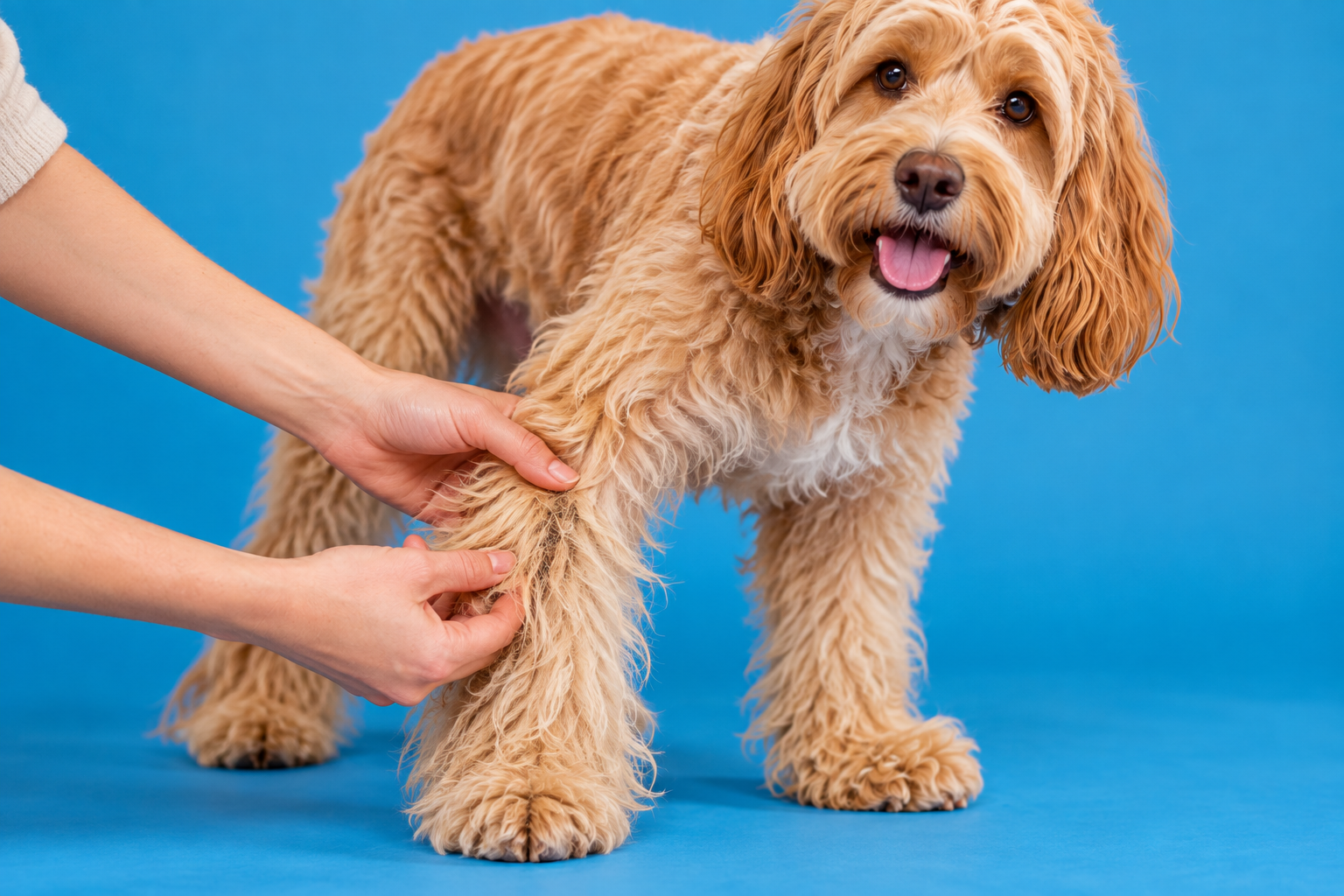
Feel through the coat with your fingers instead of judging only what you can see from the surface.
A dog’s legs move constantly and come into regular contact with grass, dirt, water, leaves, bedding, and the rest of the dog’s coat.
Longer leg hair and feathering can catch loose undercoat, small debris, and moisture. Those strands may twist together as the dog walks and bends its joints.
Because leg hair often hangs outward, the surface may still look fluffy while a knot forms underneath closer to the skin.
Run your fingers through these areas regularly, especially on dogs with long, curly, silky, or heavily feathered coats.
Hair can rub against the chest and armpit area during movement.
Long feathering may fold against itself while the dog sits, runs, or lies down.
Hair surrounding moving joints can repeatedly bend and compress.
Long hair can collect moisture, grass fragments, burrs, and dirt.
Damp hair and outdoor debris can contribute to tangles lower on the leg.
Inner-leg hair is easy to overlook during quick surface brushing.
Hair bends and rubs every time the leg moves. Long feathering can twist around neighboring strands and trap shed hair inside the coat.
Wet grass, mud, leaves, seeds, burrs, and other outdoor material can become tangled into longer leg hair.
Brushing only the visible outer coat can leave deeper tangles closer to the skin.
Small knots can tighten as more loose hair becomes trapped over time.
Gently feel around the mat with your fingertips. Notice whether it moves freely or feels compressed against the leg.
Also watch your dog’s reaction. Pain, flinching, pulling the leg away, or sudden resistance can be a sign that continuing at home is not the right approach.
If the tangle is loose and painless, work gradually. Do not pull the leg into an unnatural position just to get better access.
Support the hair near the skin and work outward from the loose edges. The goal is to separate small sections rather than drag a brush through the entire knot.
Let the dog stand, sit, or lie in a way that keeps the leg relaxed.
Identify exactly where the tangle begins and ends before brushing.
Holding the coat above the knot may reduce pulling on the skin.
Use small controlled strokes instead of forcing a tool through the center.
Gently check whether any smaller tangles remain underneath the brushed coat.
Skin can be pulled upward into compacted hair, especially around joints and narrow areas of the leg.
Cutting beneath a mat without clearly seeing the skin can cause an accidental injury. Dogs may also move suddenly when a sensitive leg is being handled.
If the mat is tight, painful, or difficult to distinguish from the skin, professional grooming is the safer next step.
Long leg hair can collect surprisingly small pieces of outdoor debris. Grass fragments, burrs, leaves, dirt, and dried mud can all become trapped inside the coat.
After wet walks or outdoor activity, check the legs before debris has time to dry into or tighten against the coat.
Mats that sit tightly around a joint or large section of the leg can be difficult to remove without repeated pulling.
A groomer may decide that carefully clipping the affected coat is more comfortable than prolonged detangling.
Veterinary evaluation may be appropriate when you find swelling, bleeding, an open wound, discharge, significant redness, or severe pain.
Visit Dog Matting Help →Leg matting is much easier to manage when small tangles are found early.
Work through the full depth of longer leg hair rather than only smoothing the surface.
A grooming comb can reveal small knots hidden beneath fluffy hair.
Remove loose debris before it becomes tangled deeper into the coat.
Damp feathering can clump and tangle as the dog moves.
Pay extra attention around joints and places where hair folds together.
A manageable trim may reduce repeated matting on dogs with heavy leg feathering.
Understand matting causes, severity, prevention, and safer next steps.
Read the guide →See how to approach mats hidden where the front leg meets the body.
Read the armpit guide →Match grooming tools to coat type, length, sensitivity, and tangles.
Use the finder →Return to the main matting hub for prevention, removal, body-area guides, and tools.
Visit Matting Help →Leg hair experiences frequent movement and may collect loose hair, moisture, dirt, or outdoor debris. Longer feathering can also twist together around joints and lower-leg areas.
A small, loose, painless tangle may sometimes be worked through gently. Dense or skin-tight mats should not be forced apart with repeated pulling or aggressive brushing.
Cutting close to a tight mat can be risky because skin may be pulled into the tangled coat. Professional grooming is safer when you cannot clearly separate the mat from the skin.
Longer feathering bends, rubs, catches shed hair, and can collect moisture and outdoor debris. Those factors make tangles easier to form.
A tight mat may pull on the skin as the leg moves, especially around joints or areas where the hair is stretched during normal movement.
Brush and comb-check the full depth of leg feathering, remove debris after outdoor activity, dry wet coat thoroughly, and keep the coat at a length you can maintain consistently.
If a mat is tight enough to pull during normal movement or your dog becomes painful when the area is handled, stop. Removing coat safely is more important than trying to preserve every strand.