Appropriate brush
Many curly coats are maintained with a slicker-style brush, though the right size and firmness depend on the individual coat.

Brush a curly coat more effectively with a simple section-by-section method that reaches beneath the surface, reduces pulling, and helps catch small tangles before they become tight mats.
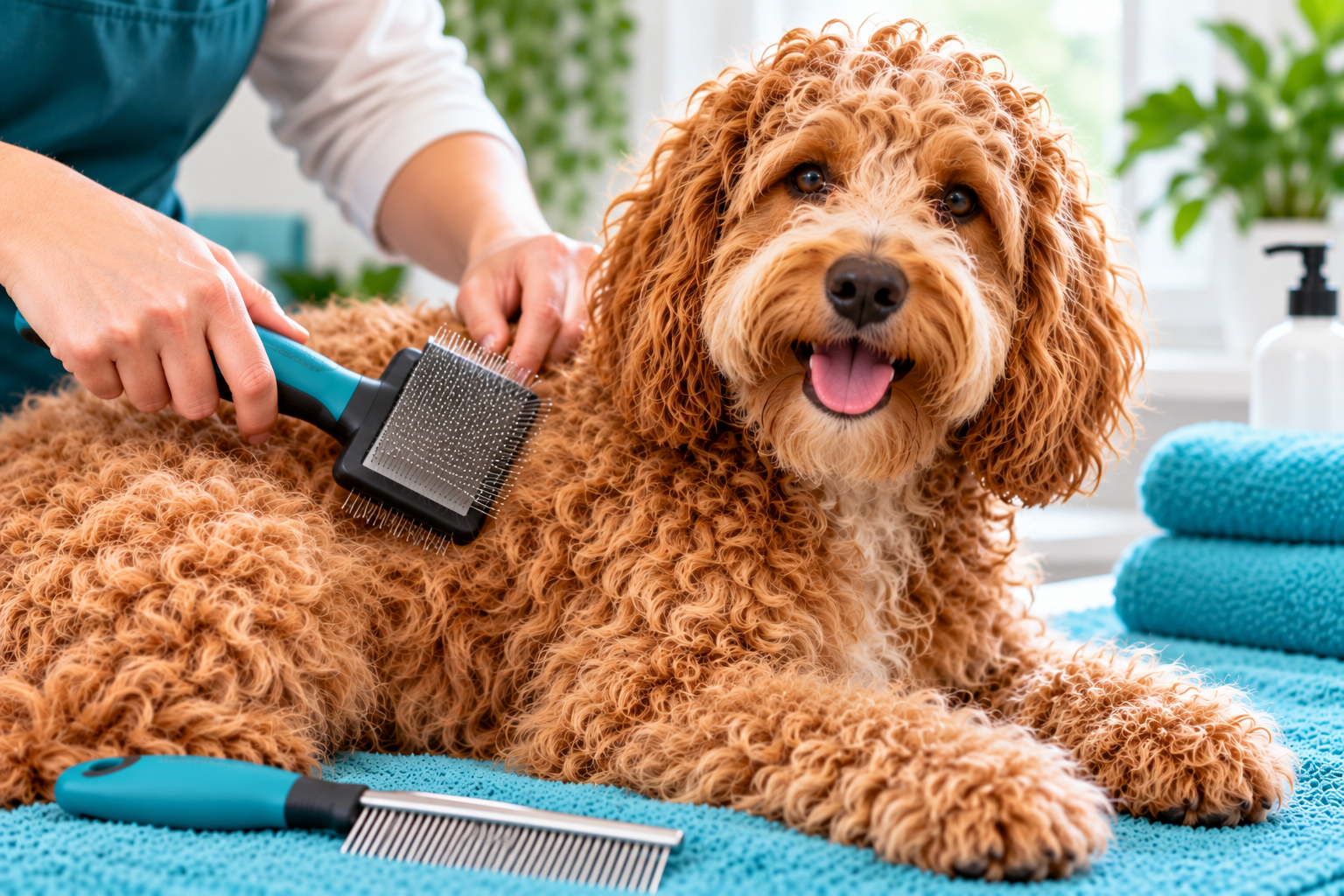
A curly coat can look brushed on top while knots remain closer to the skin. The comb check matters.
Curly and tightly wavy coats can trap loose hair inside the coat instead of letting it fall away. Those loose hairs can wrap around neighboring curls and form hidden tangles.
Quick brushing across the outside may make the coat look neat without actually reaching those deeper areas. That is why sectioning and a final comb check are so useful.
Work through small sections, gently reach closer to the skin, and use a grooming comb afterward to find areas the brush may have missed.
You do not need a pile of tools. A small, useful setup is usually enough.
Many curly coats are maintained with a slicker-style brush, though the right size and firmness depend on the individual coat.
The comb helps reveal small tangles that remain beneath the brushed outer coat.
A suitable grooming spray may make some small tangles easier to work through without excessive pulling.
Slow down and work in sections. The goal is not to finish quickly; it is to reach through the coat without making the dog uncomfortable.
If you hit a tight mat, do not turn the brushing session into a tug-of-war. Stop and assess the mat separately.
More pressure does not make a curly coat easier to groom.
Short strokes give you more control than dragging the brush through large sections of coat.
The brush should reach through the coat without repeatedly rubbing sharp pins against the same area of skin.
If the brush stops, inspect the area rather than increasing force.
Shorter sessions may be easier for dogs that become restless or uncomfortable during grooming.
Maintenance brushing is much easier than trying to recover a coat after mats have tightened.
Longer curls generally need more frequent sectioning and comb checks.
Curly coats often mat first where movement, moisture, and friction overlap.
A brush and comb do different jobs. The brush helps separate and organize the coat. The comb is a useful final check for resistance beneath the surface.
The goal is not to force the comb through. If it catches, return to that small section and inspect what is causing the resistance.
Use the Brush & Comb FinderA tight mat is different from a loose tangle. If the hair is dense, hard, close to the skin, or painful when touched, continuing to brush may make the dog more uncomfortable.
Severe matting can also hide irritated or damaged skin underneath, so the safest next step may be a professional groomer or veterinarian.
Read the Dog Matting GuideStop if the dog cries, flinches repeatedly, snaps, tries strongly to escape, or if the coat is tightly attached to the skin. Also stop if you find bleeding, wounds, swelling, discharge, or severely irritated skin.
There is no single schedule for every curly-coated dog.
A shorter coat may need less brushing time, but high-friction areas still deserve regular checks.
Moderate-length curls often need consistent brushing and comb checks to prevent hidden tangles.
Longer coats usually need more frequent maintenance because there is more hair available to twist and mat.
Continue with the guide or tool that matches what your dog needs next.
Build the broader day-to-day maintenance routine around brushing, bathing, drying, and coat length.
Read the coat-care guide →Go deeper into curly-coat grooming routines and maintenance.
Read the grooming guide →Understand matting severity, prevention, and when home detangling should stop.
Read the matting guide →Match grooming tools to coat texture, length, tangles, and sensitivity.
Use the finder →Quick answers for brushing curly and tightly wavy dog coats.
Work slowly, use gentle pressure, check beneath the surface, and stop when a tangle becomes painful or too tight to handle safely at home.