01
Tail base
Dense hair near the body may trap loose coat and hide tight knots.

Tail mats can hide underneath long feathering, tighten close to the tail base, and become harder to manage when moisture, debris, or rear-end soiling gets caught in the coat. Learn how to check the mat, what may be manageable at home, and when it is safer to get help.
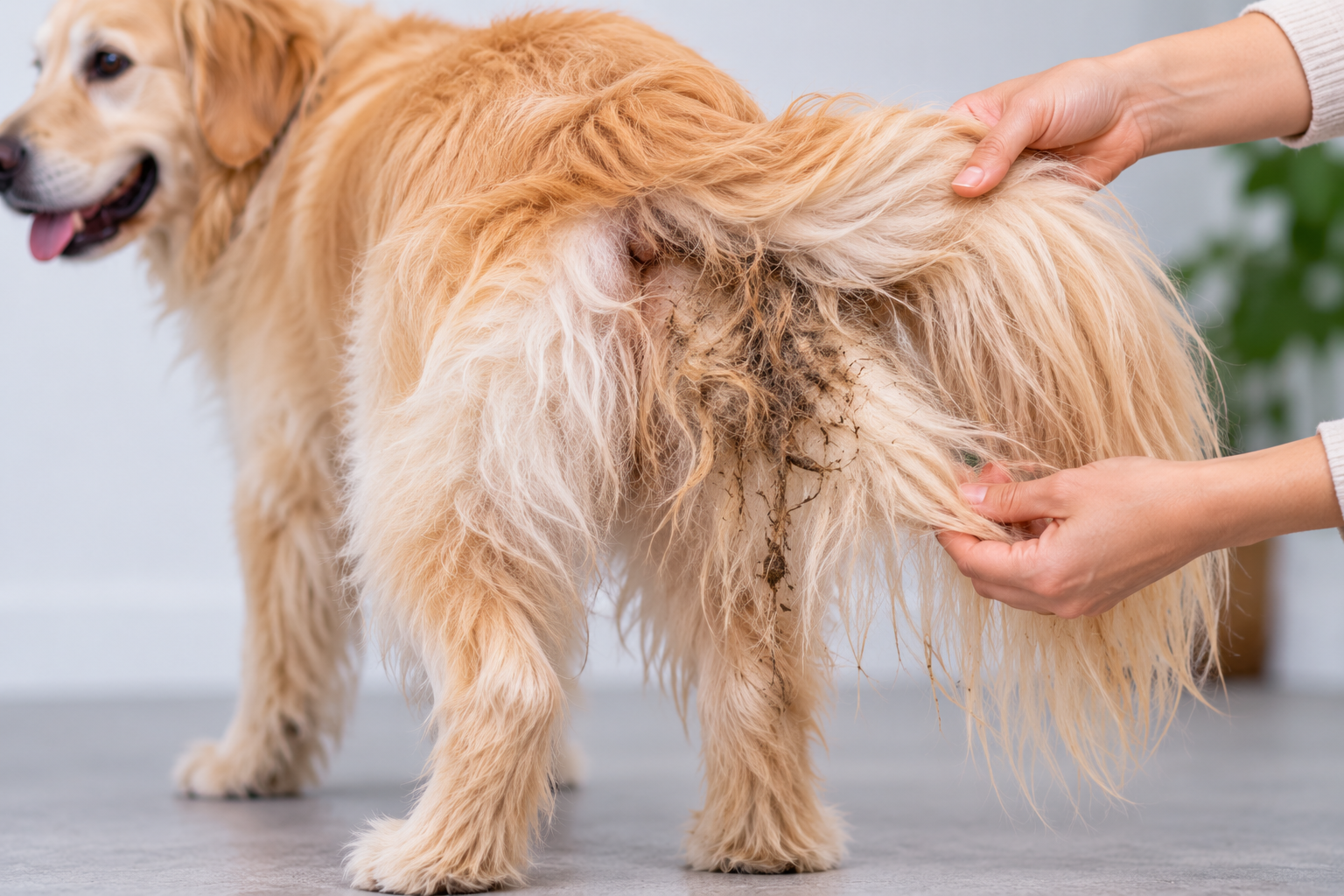
Dense mats can hide where tail movement, long hair, and rear-end friction come together.
A dog’s tail moves constantly. Long hair can twist against itself, brush against the hindquarters, collect loose coat, and pick up moisture or debris.
Mats may form along the feathering or closer to the tail base, where the coat can be dense and difficult to see through.
Rear-end hair may also become tangled when stool, dampness, mud, or other material gets caught in the coat and is not cleaned out promptly.
Dense hair near the body may trap loose coat and hide tight knots.
Hair underneath can be missed during routine brushing and may collect moisture.
Long strands can twist together as the tail moves throughout the day.
Tail hair may rub against nearby body coat and create friction.
Stool or other residue can dry into longer hair and contribute to matting.
Wet coat can clump and tighten as the tail continues moving.
Gently feel the hair around the mat before using a brush or comb. Notice whether you can move the knot independently from the skin.
Be especially careful near the tail base, where dense hair can make it difficult to tell how close the mat sits to the skin.
If your dog becomes painful, tries to sit down repeatedly, turns to guard the area, or strongly resists handling, stop.
If the knot is small, loose, and painless, work through it gradually. Avoid holding or twisting the tail into an uncomfortable position.
Support the coat close to the skin and work from the outer edges of the tangle. Do not try to force a brush through the entire knot at once.
Handle the tail gently and avoid pulling it upward or sideways unnecessarily.
Determine whether the mat is isolated or connected to a wider tangled section.
Hold the coat above a loose knot when possible to reduce pulling.
Use short, controlled strokes and stop if the mat becomes resistant.
Gently check for smaller tangles hidden beneath the surface coat.
Tail matting is not always caused by brushing gaps alone. Cleanliness around the rear end matters too.
When stool becomes trapped in longer rear-end or tail hair, it can dry into the coat and cause strands to stick together. Clean the area promptly and gently rather than allowing residue to harden.
Moisture can cause longer hair to clump together. Dry the underside of the tail and nearby coat thoroughly after bathing or cleaning.
Compacted hair can pull skin into the mat, making it difficult to tell exactly where the skin lies.
The dog may also move its tail suddenly while you are handling the area. Scissors used close to a dense mat can cause an accidental cut.
If the mat is wrapped tightly around the tail, attached close to the skin, or painful when touched, stop and let a professional groomer assess it.
Dense tail mats can be difficult to remove safely because the tail is narrow, mobile, and sometimes difficult to hold still without making the dog uncomfortable.
A groomer may decide that carefully removing the affected coat is kinder than prolonged brushing or detangling.
Veterinary evaluation may be appropriate if the skin appears swollen, bleeding, wounded, very painful, infected-looking, or has discharge or a strong unusual odor.
Visit Dog Matting Help →Work through the full depth of the coat instead of brushing only the surface.
Use your fingers to feel for small knots hidden close to the body.
Remove stool or other residue before it dries into longer hair.
Damp rear-end hair can clump and tangle as the dog moves.
A grooming comb can reveal smaller tangles beneath long feathering.
Keeping rear-end coat at a practical length may reduce repeat matting.
Understand matting causes, severity, prevention, and safer next steps.
Read the guide →Get help with mats around feathering, joints, and lower-leg coat.
Read the leg guide →Match grooming tools to coat texture, length, sensitivity, and tangles.
Use the finder →Return to the main matting hub for prevention, body-area guides, severe matting help, and tools.
Visit Matting Help →Tail movement, long feathering, trapped loose hair, moisture, friction against the hindquarters, and rear-end soiling can all contribute to repeated tail matting.
A small, loose, painless tangle may sometimes be worked through gently. Dense, wrapped, painful, or skin-tight mats should not be forced apart with repeated brushing.
Cutting close to a dense mat can be risky because skin may be pulled into the tangled coat and the dog may move its tail suddenly.
Gently clean loose surface contamination when it can be done comfortably. If stool is trapped inside dense or skin-tight matting, professional grooming may be safer than pulling or cutting.
Tight matting can pull on the skin as the tail moves, particularly near the tail base or when a mat connects several sections of hair.
Brush and comb-check the full depth of the tail coat, check the tail base regularly, keep the rear-end coat clean and dry, and maintain a coat length that is practical for your grooming routine.
If a tail mat is tight, painful, wrapped close to the skin, or badly contaminated, stop. Professional removal may be kinder and safer than prolonged brushing, pulling, or cutting in a narrow moving area.