Curly Dog Coat Grooming
Curly dog coats can look soft, fluffy, and easy to manage, but they often need more care than owners expect.
A curly coat can trap loose hair inside the coat instead of dropping it onto the floor. The surface may look brushed while small tangles are forming underneath. If those tangles are missed, they can tighten into mats close to the skin.
That is why curly-coated dogs often need regular brushing, careful comb checks, proper drying, and consistent professional grooming.
This guide explains how curly dog coats work, which tools are commonly used, how to brush the coat safely, and when matting may need help from a groomer or veterinarian.
What Is a Curly Dog Coat?
A curly dog coat has hair that grows in curls, waves, coils, or tight textured patterns rather than lying flat against the body.
Some curly coats are soft and loose. Others are dense, wool-like, or cottony. Some dogs have a mix of curl patterns across the body.
Curly coats may be seen in breeds and mixes such as:
- Poodles
- Bichon Frises
- Portuguese Water Dogs
- Lagotto Romagnolos
- Barbets
- Spanish Water Dogs
- Goldendoodles
- Labradoodles
- Cavapoos
- Cockapoos
- Bernedoodles
- Aussiedoodles
- curly-coated mixed breeds
The exact grooming routine depends on the dog’s actual coat, not just the breed name.
A loose wavy coat may need a different routine from a dense curly coat. A clipped coat may need different care from a long fluffy coat. A puppy coat may also change as the dog matures.
Why Curly Dog Coats Mat Easily
Curly coats often mat because loose hair becomes trapped inside the coat.
With some short-haired dogs, shed hair falls out easily. With many curly-coated dogs, shed hair stays in the coat and wraps around nearby curls. Moisture, friction, and missed brushing can make the tangles tighten.
Common causes of matting in curly coats include:
- surface brushing that misses the lower coat
- loose hair trapped inside curls
- long fluffy haircuts
- moisture from bathing, swimming, rain, or snow
- air-drying a tangled coat
- collars, harnesses, sweaters, or coats rubbing the hair
- missed grooming appointments
- not using a comb after brushing
- puppy coat changes
- sensitive dogs resisting brushing
- thick coat around ears, armpits, legs, tail, and belly
Curly coats can hide tangles well. A dog may still look cute and fluffy while mats are forming near the skin.
The ASPCA notes that regular brushing and combing help prevent tangles and keep the skin clean, while dogs with matted or dirty coats may be more prone to skin issues such as hot spots. See the ASPCA’s general dog grooming guidance here: ASPCA Dog Grooming Tips.
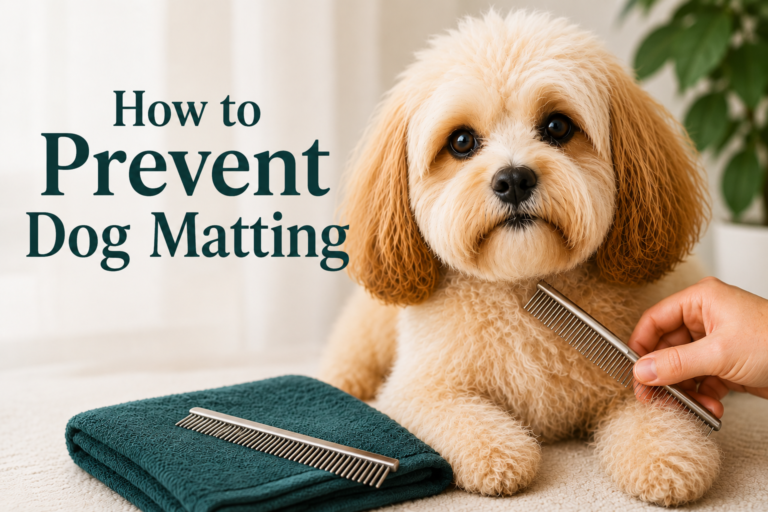
The Most Important Rule: Brush and Then Comb
For curly dog coat grooming, brushing alone is often not enough.
A brush may smooth the top layer while hidden tangles remain underneath. A metal grooming comb helps confirm whether the coat is actually brushed through.
A good routine is:
- Brush a small section.
- Check that same section with a metal comb.
- Move to the next section only when the comb passes gently.
If the comb catches, do not yank. Stop, inspect the area, and work more gently.
The comb is what tells you the truth about the coat.
Best Tools for Curly Dog Coat Grooming
The right tools depend on coat density, length, sensitivity, and condition. Many curly-coated dogs do best with a small grooming toolkit rather than one brush.
Long-pin slicker brush
A long-pin slicker brush is often useful for curly coats because the longer pins can reach deeper into the coat.
Use it gently. Do not scrape the skin. Do not repeatedly brush the same area until the skin turns red.
A slicker brush may help with:
- separating curls
- removing loose trapped hair
- preventing small tangles
- brushing in sections
- maintaining fluffy coats between grooming visits
Metal grooming comb
A stainless-steel comb is essential for checking the coat after brushing.
A comb with wider and narrower teeth is helpful. Start with the wider side. Use the narrower side only when the coat is already moving freely.
Use the comb carefully around ears, legs, face, tail, and armpits.
Pin brush
A pin brush may help with looser curly or wavy coats, especially when the coat is not deeply tangled.
It may be gentler than a slicker for some dogs, but it may not reach dense lower coat as well.
Detangling or conditioning spray
A dog-safe detangling or conditioning spray may help with small loose tangles and reduce friction during brushing.
It should not be used as a way to force through tight mats.
Use only products made for dogs and follow the label directions.
Grooming dryer
Curly coats often need careful drying after baths.
A professional-style grooming dryer can help separate the coat as it dries, but it must be used safely. Avoid high heat, monitor the dog’s comfort, and stop if the dog becomes overheated or distressed.
If drying a curly coat at home is difficult, ask a groomer for help.
Use the Dog Brush and Comb Finder if you are unsure which brush-and-comb setup fits your dog’s current coat.
How to Brush a Curly Dog Coat
Curly coats should be brushed in small sections.
This is often called line brushing.
Here is a simple method:
- Place the dog on a safe, non-slip surface.
- Choose one small section of coat.
- Use your fingers to separate the hair so you can see into the coat.
- Hold the coat near the skin to reduce pulling.
- Brush gently from the ends of the hair toward the roots.
- Use short, light strokes.
- Check the section with a metal comb.
- Move to the next section only when the comb passes through easily.
Do not rush through the whole dog with quick surface strokes. That is how hidden mats are missed.
High-Risk Matting Areas on Curly Dogs
Curly-coated dogs often mat in the same areas repeatedly.
Check these spots often:
- behind the ears
- under the collar
- under the harness
- armpits
- chest
- belly
- inner legs
- groin
- tail base
- feet and toes
- beard and mouth area
- sanitary area
- anywhere clothing rubs
Harnesses are a common problem. If a curly-coated dog wears a harness daily, check the strap areas frequently.
Moisture around the mouth, feet, belly, and tail can also lead to tangles.
Should You Brush a Curly Dog Before Bathing?
Yes, in most cases.
Bathing a tangled curly coat can make knots tighter. Water can cause loose tangles to clump. Shampoo may not reach the skin properly when the coat is packed.
Before bathing:
- check the coat with your fingers
- brush in small sections
- comb-check high-risk areas
- gently loosen small tangles
- avoid bathing a severely matted coat at home
After bathing, dry the coat thoroughly. A damp curly coat can tighten as it dries.
Drying a Curly Dog Coat
Drying is one of the most important parts of curly dog coat grooming.
A curly coat may feel dry on the surface while moisture remains deeper inside. If the coat is left damp, curls can clump together and tangle.
After a bath or swim:
- blot the coat gently with a towel
- avoid rough rubbing
- separate the coat as it dries
- dry the coat thoroughly
- brush and comb-check once the coat is ready
- pay extra attention to ears, armpits, belly, feet, and tail
VCA Animal Hospitals explains that matted fur can prevent air from reaching the skin and may retain water after swimming or rain, creating conditions where hot spots can develop. Read more from VCA here: Hot Spots in Dogs.
Do not use high heat close to the skin. Do not keep drying if the dog is panting heavily, panicking, or trying to escape.
How Often Should You Brush a Curly-Coated Dog?
The right schedule depends on the coat length and density.
A long fluffy curly coat may need brushing and comb checks several times per week, sometimes daily in high-risk areas.
A shorter maintained trim may need less work, but it still needs regular checks.
A practical starting schedule:
Daily quick check
Check behind the ears, armpits, collar area, harness area, tail, feet, and belly.
Several times per week
Brush in sections and follow with a comb check.
Before every bath
Brush and comb-check before the coat gets wet.
After wet activity
Dry thoroughly and check for clumps or developing tangles.
Between grooming appointments
Ask your groomer what areas are tangling and adjust your routine.
If mats keep appearing between appointments, the routine is not working yet.
Puppy Coat Changes in Curly Dogs
Curly-coated puppies may become harder to maintain as the adult coat comes in.
During the coat-change period, texture, density, and curl pattern may change. A routine that worked at first may suddenly stop being enough.
During this stage:
- brush more often
- comb-check carefully
- keep the coat at a manageable length
- avoid missing grooming appointments
- ask the groomer where mats are forming
- do not assume the puppy coat will stay the same
Many owners are surprised by how quickly a curly puppy coat can become difficult.
Keeping a Curly Coat Long vs Short
A long curly coat can look beautiful, but it requires consistent care.
A shorter trim may be better when:
- the dog mats between grooming visits
- brushing is often missed
- the dog dislikes long grooming sessions
- the dog wears a harness daily
- the dog swims often
- the coat stays damp too long
- the owner cannot keep up with comb checks
- the groomer repeatedly finds hidden mats
A shorter coat is not a failure. It can be a kind and practical choice.
The best coat length is one the dog can comfortably maintain with the care the household can realistically provide.
The AKC notes that a full-coated Poodle needs brushing and combing completely to the skin to prevent matting, and many owners choose professional grooming every few weeks. See the AKC’s Poodle breed guidance here: Standard Poodle Breed Information.
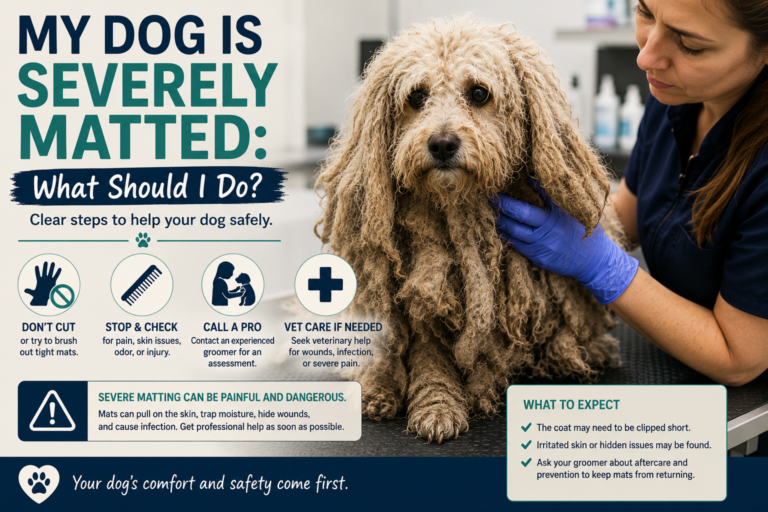
When Curly Dog Mats Should Not Be Brushed Out
Not every mat should be brushed out.
Stop and call a groomer when:
- the mat is tight against the skin
- the comb cannot enter the coat
- the skin cannot be seen
- several mats are connected
- the dog cries, growls, snaps, freezes, or panics
- mats are near ears, armpits, groin, tail, feet, or face
- the area smells bad or feels damp
- there is redness, swelling, discharge, bleeding, or pain
Do not cut under mats with scissors. Skin can be pulled into the mat and may be cut accidentally.
For serious matting, read How to Remove Matted Dog Hair and What to Do When Your Dog Is Severely Matted.
Professional Grooming for Curly Dogs
Many curly-coated dogs need regular professional grooming.
A groomer can help with:
- bathing
- drying
- clipping
- coat shaping
- mat removal
- sanitary trims
- ear and paw area maintenance
- haircut planning
- identifying problem areas
- recommending a home routine
Ask your groomer:
- How often should this dog come in?
- Is the current coat length realistic?
- Which areas are matting the fastest?
- What brush and comb should I use?
- Can you show me how to brush in sections?
- Should the dog have a shorter trim?
- What should I do after bathing or swimming?
- When should I stop brushing and book help?
The Dog Groomer Interview Assistant can help you prepare questions before calling or booking.
Common Curly Coat Grooming Mistakes
Avoid these mistakes:
- brushing only the surface
- skipping the comb check
- bathing before removing tangles
- letting the dog air-dry while tangled
- leaving a harness on without checking underneath
- using scissors under mats
- using a slicker brush too harshly
- waiting too long between grooming appointments
- trying to keep the coat long when it repeatedly mats
- blaming the dog when the routine is unrealistic
Curly coat grooming is not just about tools. It is about consistency, technique, and choosing a manageable coat length.
Simple Curly Coat Routine
Here is a basic routine many curly-coated dogs may benefit from:
Daily
Check high-risk areas with your fingers.
Several times per week
Brush in small sections and comb-check after brushing.
Before baths
Brush and comb-check before the coat gets wet.
After baths
Dry thoroughly and check for clumps or tangles.
Every grooming appointment
Ask the groomer what changed and what to focus on at home.
Anytime mats return
Review the haircut, brushing frequency, drying method, and appointment schedule.
Final Thoughts
Curly dog coat grooming takes consistency.
These coats can hide tangles under the surface, especially around the ears, armpits, belly, legs, tail, and harness areas. A quick brush over the top is not enough.
Use the right brush, work in small sections, check with a metal comb, dry the coat properly, and schedule grooming before the coat becomes difficult.
The goal is not maximum fluff.
The goal is a clean, comfortable, mat-free coat that can realistically be maintained.
Related Dematly Resources
- Grooming Curly and Doodle-Type Coats
- Dog Brush and Comb Finder
- How to Prevent Dog Matting
- How to Remove Matted Dog Hair
- Best Brushes for Long-Haired Dogs
- Dog Grooming Tools
- Dog Grooming Routines
- Professional Dog Grooming
Dematly provides general educational dog-grooming information and does not replace advice from a veterinarian or qualified professional groomer.