
What to Do When Your Dog Is Severely Matted
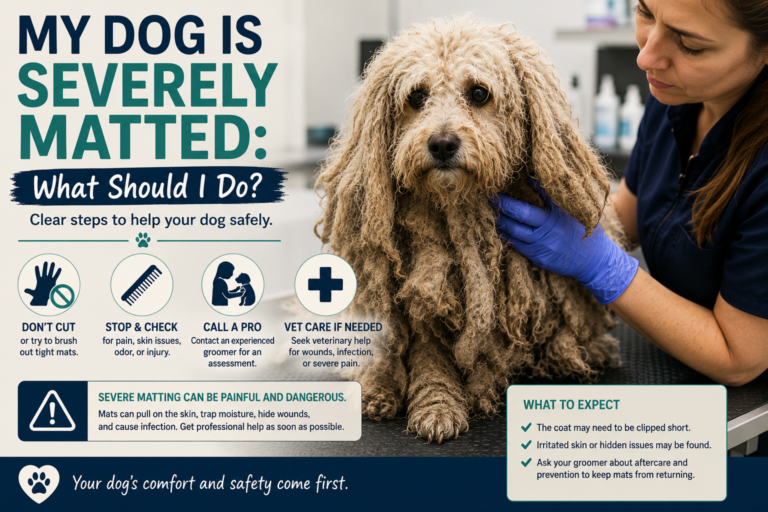
A few small tangles can sometimes be handled with patient brushing. Severe matting is different. When a dog’s coat becomes tightly packed, tangled close to the skin, or covered with connected mats, the problem is no longer just cosmetic.
The coat may pull painfully whenever the dog moves. Moisture, dirt, parasites, wounds, and irritated skin can remain hidden underneath. Trying to remove the coat without the right tools or experience can also cause cuts, burns, fear, and unnecessary pain.
The safest next step depends on how tight the mats are, where they are located, how the dog reacts to handling, and what the skin looks like underneath.
This guide explains how to recognize severe matting, what not to do, when to call a professional groomer, and when a veterinarian may need to become involved.
How Dematly Began
Dematly was inspired by a real experience with Chocolate Chip, an all-black Shih Tzu belonging to my daughter.
At one point, Chocolate Chip became severely matted. The coat was no longer dealing with a few loose tangles. It had become dense, difficult to separate, and far beyond an ordinary brushing session.
Like many dog owners facing this for the first time, I wanted to solve the problem quickly. I purchased a large electric shear that was designed more like equipment for livestock than a normal pet-grooming clipper.
The tool removed the coat, but the experience taught me something important: owning a powerful cutting tool does not mean it is the safest or most appropriate tool for a dog.
A severely matted coat can hide folds of skin, irritated areas, lumps, wounds, and uneven surfaces. Heavy shears can be difficult to control around a small dog’s legs, armpits, ears, face, belly, and other sensitive areas.
That experience became part of the reason Dematly exists.
Dog owners need practical information before the coat reaches that point. They also need honest guidance when matting has already become too serious for ordinary home grooming.
What Severe Dog Matting Looks Like
Severe matting does not always look dramatic from a distance.
A dog may still appear fluffy, especially when loose hair covers the outside of a tightly packed coat. The true condition may only become obvious when you try to part the hair or move a comb through it.
Signs of serious matting may include:
- Large sections of coat that feel hard, dense, or felt-like
- Mats that sit directly against the skin
- Several mats joined together into one connected layer
- Hair that cannot be separated with the fingers
- A comb that cannot reach the skin
- Matting around the ears, collar, armpits, belly, tail, legs, or sanitary areas
- A bad odor trapped within the coat
- Dampness, debris, or discoloration beneath the hair
- A dog that flinches, growls, cries, or moves away when the coat is touched
- Skin that appears red, swollen, crusted, bleeding, or irritated after a mat is lifted
Some dogs tolerate discomfort quietly. A calm dog may still be experiencing constant pulling or skin irritation.
Why Severe Matting Can Be Painful
A mat is not simply a knot sitting on top of the coat.
As loose hairs twist together, they can tighten into a dense mass. The mat may pull on the skin every time the dog walks, lies down, scratches, turns its head, or moves a leg.
This pulling can be especially uncomfortable in areas where the skin is thin or frequently moving, including:
- Behind the ears
- Under the collar
- In the armpits
- Around the groin
- Between the legs
- Around the tail
- Near the mouth
- Beneath the belly
- Around the feet and toes
Tight matting may also restrict airflow and hold moisture against the skin. The coat can conceal inflammation, sores, urine, fecal matter, parasites, foreign objects, or other problems.
Removing the coat may reveal skin that looks worse than expected. That does not necessarily mean the grooming process caused the entire problem. In many cases, the damaged or irritated skin was already hidden under the mat.
Do Not Pull, Rip, or Cut Blindly
When owners discover a severe mat, the first instinct is often to pull it apart, brush harder, or reach for scissors.
Those reactions can make the situation more dangerous.
Do not force a brush through a tight mat
Repeated hard brushing may pull painfully on the skin and create brush irritation. It may also make the dog increasingly fearful of grooming.
Do not place scissors beneath a mat
A dog’s skin can be pulled upward into the tangled coat. What appears to be empty space beneath the mat may actually contain folded skin.
One sudden movement can lead to a serious cut.
Do not use a mat splitter without understanding the risk
Mat splitters and sharp dematting tools can be helpful in limited situations, but they contain blades. They are not automatically safe simply because they are sold as grooming tools.
Do not bathe a severely matted coat first
Water can tighten some mats and make the packed coat more difficult to work through. Shampoo may also fail to reach the skin properly beneath dense matting.
Do not use livestock shears
Large livestock or sheep shears are not designed for the detailed contours and sensitive areas of normal dog grooming.
They may be powerful, but power is not the same as control.
For more guidance about safe grooming equipment, visit the Dematly Dog Grooming Tools guide.
Should You Brush Out the Mats or Clip the Coat?
That decision should be based on the dog’s comfort and coat condition, not only on how much hair the owner wants to preserve.
A few loose tangles may sometimes be separated with fingers, a suitable comb, a detangling product, and patient work.
Tight, widespread, painful matting is different.
Trying to save a long coat can require extended pulling, brushing, restraint, and repeated handling. Even when a mat can technically be brushed out, that does not always mean it should be.
Clipping the coat shorter may be the kinder option when:
- Mats are tight against the skin
- Large sections of the coat are connected
- The dog is clearly uncomfortable
- Brushing causes pain or panic
- The matting covers sensitive areas
- The skin cannot be seen
- The dog is elderly, weak, fearful, or physically limited
- A long dematting session would cause excessive stress
A short haircut can be disappointing, but coat length grows back. Avoiding unnecessary pain should come first.
When to Contact a Professional Groomer
An experienced professional groomer should evaluate the coat when the matting is beyond a few loose tangles.
A groomer may be able to determine:
- How close the mats are to the skin
- Whether the coat can be safely brushed or must be clipped
- What blade length may pass beneath the mat
- Whether the dog can tolerate the service
- Which areas require extra caution
- Whether the skin appears damaged
- Whether the appointment should stop and be referred to a veterinarian
Before booking, explain the matting honestly.
Do not describe a severely packed coat as “a few knots.” Accurate information helps the groomer schedule enough time, prepare appropriate equipment, and decide whether the dog can be safely handled in a normal grooming salon.
Useful questions include:
- Do you regularly work with severely matted dogs?
- How do you decide whether to brush or clip the coat?
- Will you contact me before making a major haircut change?
- What happens if you find wounds or damaged skin?
- How do you handle dogs that become frightened or resistant?
- Are there additional charges for matting?
- When would you refer a dog to a veterinarian?
- How long might the dog remain at the salon?
- What aftercare should I expect following a close clip?
The free Dog Groomer Interview Assistant can create a personalized question list based on your dog’s coat, behavior, matting history, and appointment needs.
When a Veterinarian May Be Needed
Some severely matted dogs should be evaluated by a veterinarian before or instead of a standard grooming appointment.
Veterinary involvement may be appropriate when:
- The dog has open wounds or bleeding
- The skin appears infected
- There is a strong odor, discharge, or swelling
- The dog seems painful even when lightly touched
- Matting is wrapped tightly around a limb, toe, tail, or ear
- The dog has breathing, heart, mobility, or neurological concerns
- The dog is extremely fearful or cannot be handled safely
- Sedation may be considered
- The dog is elderly, medically fragile, or recovering from surgery
- The coat contains feces, urine, parasites, or foreign material near damaged skin
Medication or sedation decisions belong with a veterinarian.
A groomer may stop a service if the dog is unsafe to handle, too distressed, or in need of medical care. That is not a failure. Stopping may be the most responsible decision.
What to Expect After a Severely Matted Coat Is Removed
The dog may look dramatically different after clipping.
Owners are sometimes shocked by how short the coat must be. The groomer may have very little control over the final length because the blade must pass beneath the mat.
After the coat is removed, you may notice:
- Red or irritated skin
- Uneven-looking coat length
- Areas of thin hair
- Previously hidden wounds or sores
- Lumps, bumps, or skin changes
- Sensitivity to touch
- Increased scratching or licking
- A dog acting unusually tired after a stressful appointment
Some dogs may also behave differently because the skin suddenly feels air, touch, or temperature changes that the dense coat had blocked.
Contact a veterinarian if the dog develops significant redness, swelling, discharge, bleeding, pain, persistent licking, unusual weakness, breathing difficulty, or any symptom that concerns you.
How to Care for the Skin After a Close Clip
Follow the groomer’s or veterinarian’s instructions.
General precautions may include:
- Keep the dog warm in cool weather
- Avoid strong sun exposure on newly uncovered skin
- Prevent excessive licking or scratching
- Avoid applying human creams or medications without veterinary advice
- Keep bedding clean and dry
- Watch for redness, swelling, odor, discharge, or worsening irritation
- Use only products appropriate for dogs
- Allow the dog time to rest after the appointment
A close clip is not the right time to experiment with several new sprays, oils, shampoos, or home remedies.
The skin may already be sensitive.
For more information about routine observations, see Dog Skin and Coat Care.
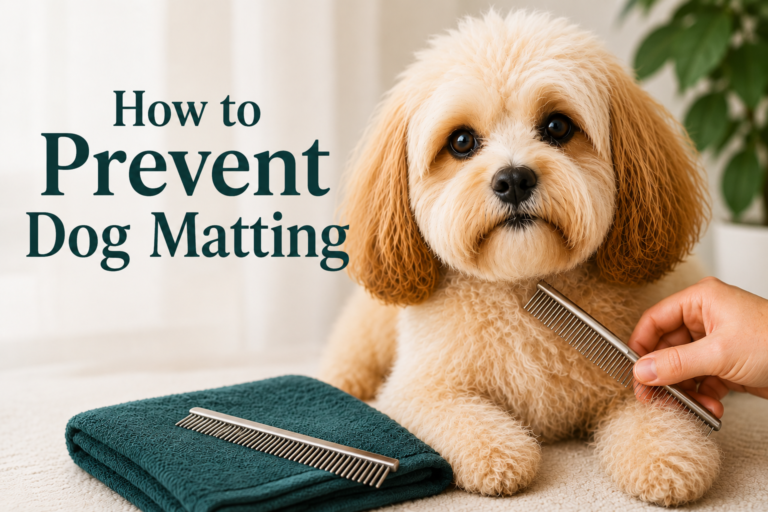
How to Prevent Severe Matting From Returning
Preventing another severe episode is usually easier and more comfortable than removing a packed coat.
The correct routine depends on coat type, coat length, activity, grooming tolerance, and how often the dog receives professional grooming.
Brush to the skin
Brushing only the surface can leave tangles underneath.
Use a technique that separates the coat in small sections and checks each area from the skin outward. This is often called line brushing.
Follow with a comb
A brush may glide over the top while hidden tangles remain below.
A suitable metal comb can help reveal areas that still need attention. Never force the comb through resistance.
Focus on high-friction areas
Check frequently:
- Behind the ears
- Under the collar or harness
- Armpits
- Chest
- Belly
- Groin
- Legs
- Tail
- Feet
- Areas where clothing rubs
Dry the coat properly
A damp, tangled coat can tighten as it dries.
After bathing or swimming, dry the coat thoroughly and gently work through developing tangles.
Keep a manageable coat length
A long coat requires more frequent and detailed maintenance.
Choosing a shorter trim is not neglect. For many households, a manageable haircut produces a cleaner, more comfortable dog and a routine the owner can realistically maintain.
Schedule professional grooming before matting develops
Do not wait until the coat becomes unmanageable.
Ask the groomer what appointment interval fits the dog’s coat, haircut, lifestyle, and home-care routine.
Make grooming easier for the dog
Use short, calm sessions rather than waiting for one long stressful session.
Reward cooperation. Handle paws, ears, legs, and the tail gently. Stop before the dog becomes overwhelmed.
A dog that fears brushing may need a slower training approach rather than stronger restraint.
A Simple Weekly Matting Check
Once a week, use your fingers and a comb to check the coat carefully.
Pay attention to:
- Behind both ears
- Beneath the collar
- Each armpit
- The chest and belly
- The inner legs
- The groin and sanitary area
- The tail base
- The feet and toes
- Any area covered by clothing or a harness
A small tangle found early may take a minute to address. The same area ignored for several weeks can become painful and difficult.
Severe Matting Is a Problem to Solve, Not a Reason for Shame
Dog owners sometimes delay calling a groomer because they feel embarrassed.
That delay can allow the coat to tighten further.
Matting can happen because of:
- An illness in the family
- A change in the dog’s health
- Fear or resistance during grooming
- An unsuitable brush
- Surface brushing that misses the undercoat
- A missed grooming appointment
- A coat change
- Swimming or wet weather
- Clothing or harness friction
- Simply not realizing how quickly the coat can tighten
The useful question is not, “How did I let this happen?”
The useful question is, “What is the safest next step for the dog, and what routine will prevent it from happening again?”
Final Thoughts
Severe matting should not be treated as an ordinary brushing problem.
Do not pull aggressively, cut blindly beneath mats, bathe a packed coat without guidance, or use oversized equipment simply because it appears powerful enough to remove the hair.
The safest plan may involve a professional groomer, a veterinarian, or both.
Once the coat has been addressed, build a realistic maintenance routine based on the dog’s actual coat and your ability to keep up with it. A shorter, manageable coat is often better than a long style that repeatedly becomes painful and matted.
The goal is not to preserve every inch of hair.
The goal is a cleaner, safer, more comfortable dog.
Related Dematly Resources
- Dog Matting Help
- Dog Coat Types
- Dog Grooming Routines
- Dog Grooming Tools
- Dog Skin and Coat Care
- Professional Dog Grooming
- Dog Groomer Interview Assistant
- Shih Tzu Groomer Finder
Dematly provides general educational information and does not replace advice from a veterinarian or qualified professional groomer. Contact a veterinarian when a dog has pain, wounds, infection, breathing difficulty, severe distress, or another medical concern.