Why Does My Dog Keep Getting Mats?
Some dogs seem to develop mats almost as soon as you finish brushing them.
You may clear the coat one day and find tangles behind the ears, under the legs, around the tail, or beneath a harness just a few days later. That can make it feel as if brushing is not working.
Usually, recurring mats are not caused by one thing.
They are more often the result of a combination of coat type, friction, trapped loose hair, moisture, missed problem areas, coat length, and grooming frequency.
The good news is that once you understand where the mats are forming and why, the routine becomes much easier to adjust.
Quick Answer: Why Does My Dog Keep Getting Mats?
Dogs commonly develop repeated mats because:
- the coat is long, curly, silky, or dense
- loose hair is getting trapped in the coat
- brushing is only reaching the surface
- a comb check is being skipped
- collars or harnesses are creating friction
- moisture is being trapped after bathing, rain, or swimming
- high-risk areas are not being checked often enough
- the coat is too long for the current routine
- grooming appointments are spaced too far apart
- the dog does not tolerate brushing well
- puppy coat is changing into adult coat
AKC notes that mats often develop in high-friction areas, including where the legs meet the chest, and can also begin where dampness or debris collects in the coat. (American Kennel Club)
If mats keep returning, the answer is usually not simply “brush harder.”
It is to change the routine.
Some Coats Mat More Easily Than Others
Certain coat types naturally tangle more easily.
Dogs with:
- long coats
- silky coats
- curly coats
- wavy coats
- dense double coats
- soft cottony coats
- feathering around the legs and tail
may need more maintenance.
Examples include Shih Tzus, Maltese, Yorkshire Terriers, Havanese, Poodles, Bichon Frises, Doodles, Cocker Spaniels, Old English Sheepdogs, and many mixed breeds.
This does not mean every dog of these breeds will mat the same way.
Two dogs of the same breed may have very different coat texture, thickness, length, and grooming needs.
Surface Brushing Is One of the Biggest Reasons Mats Return
A dog can look beautifully brushed while still having tangles close to the skin.
This happens when the brush smooths the outer coat but never reaches the deeper layer.
AKC recommends brushing all the way through the coat and checking for mats, debris, cuts, and other abnormalities. (American Kennel Club)
For mat-prone coats, a better routine is:
- Work in small sections.
- Separate the hair with your fingers.
- Brush gently through the full depth of the coat.
- Follow with a metal comb.
- Move on only when the comb passes through without catching.
The comb is often what reveals the tangles the brush missed.
Brush First, Then Comb
For many mat-prone dogs, brushing alone is not enough.
A metal grooming comb is useful because it tells you whether the coat is actually clear.
Try this simple rule:
If the comb cannot pass through gently, the coat is not finished.
Do not yank the comb through resistance.
Stop and inspect the area.
A small tangle is much easier to handle than a tight mat a week later.
Use the Dog Brush and Comb Finder if you are unsure which tools fit your dog’s coat.
Friction Creates Mats
Some areas mat repeatedly because hair is rubbing against itself.
Common friction areas include:
- behind the ears
- under collars
- under harness straps
- armpits
- chest
- inner legs
- belly
- groin
- tail base
- sanitary area
AKC specifically identifies friction areas as common places for mats to develop. (American Kennel Club)
If your dog wears a harness every day, check under the straps often.
A coat can be perfectly brushed elsewhere and still mat badly beneath a harness.
Suggested In-Article Image: Common Matting Areas
A useful image here could show a long-haired or curly dog with gentle callouts for:
- behind ears
- collar area
- armpits
- belly
- tail
- legs
- paws
Moisture Makes Matting Worse
Wet or damp hair tangles more easily.
Common sources include:
- bathing
- swimming
- rain
- snow
- wet grass
- drool around the beard
- damp paws
- skin folds
AKC notes that mats may begin in damp areas, and VCA explains that moisture trapped under matted fur can contribute to painful hot spots. (American Kennel Club)
After your dog gets wet:
- blot gently with a towel
- avoid rough rubbing
- dry the coat thoroughly
- brush and comb-check once appropriate
- pay extra attention to high-risk areas
A coat that air-dries while tangled can tighten quickly.
Bathing Over Tangles Can Make Them Worse
If you bathe a dog before removing loose tangles, those tangles may become tighter.
This is especially true for:
- long coats
- curly coats
- Doodle-type coats
- silky coats
- dense coats
Before bathing, check the coat thoroughly.
If the dog is already heavily matted, do not assume a bath will make brushing easier.
It may make the situation harder.
Loose Hair Can Become Trapped
Not all shed hair falls onto the floor.
In long, curly, and dense coats, loose hair may remain inside the coat.
That loose hair wraps around nearby hairs and starts forming tangles.
This is why a dog that does not appear to shed much can still develop severe mats.
Curly-coated dogs are a good example. Loose hair may stay trapped inside the curls rather than falling away.
Read Curly Dog Coat Grooming for a deeper guide.
Coat Length May Be Too Difficult to Maintain
Sometimes the grooming routine is reasonable, but the coat is simply too long.
A long fluffy haircut requires more work than a shorter trim.
A shorter coat may make sense if:
- mats repeatedly return between grooming appointments
- brushing takes too long
- the dog dislikes grooming
- the household cannot maintain daily or frequent coat care
- the dog swims often
- harness friction keeps causing mats
- the coat remains damp too long
Keeping the coat shorter is not a failure.
A comfortable short coat is better than a beautiful long coat that repeatedly becomes painful.
Grooming Appointments May Be Too Far Apart
Professional grooming schedules matter.
A dog that stays comfortable with a six-week appointment schedule may become badly tangled at eight or ten weeks.
Ask your groomer:
- How quickly is the coat growing?
- Which areas are matting first?
- Should appointments be closer together?
- Would a shorter trim help?
- What should I brush at home?
- Which tool should I use?
- Am I brushing deeply enough?
The Dog Groomer Interview Assistant can help you prepare questions before an appointment.
Puppy Coat Changes Can Cause Sudden Matting
A puppy may be easy to brush for months and suddenly begin matting.
This often happens when the adult coat begins coming in.
During coat transition, texture and density can change. Soft puppy coat may become mixed with a denser adult coat, making tangles form faster.
During this period:
- brush more frequently
- use a comb after brushing
- keep grooming appointments consistent
- consider a shorter trim
- ask your groomer where tangles are forming
Do not assume the puppy’s earlier grooming schedule will continue to work.
The Dog May Be Resisting Because Brushing Hurts
Some dogs hate brushing because grooming has become uncomfortable.
AKC notes that dogs can remember previous frightening or painful brushing experiences. (American Kennel Club)
A dog may:
- run away
- hide
- freeze
- growl
- snap
- turn toward the brush
- sit down
- refuse to stand
Do not assume the dog is simply being stubborn.
Check for:
- tight mats
- irritated skin
- wounds
- sore joints
- ear problems
- sensitive areas
If brushing hurts, forcing the session can make future grooming even harder.
Overbrushing Can Also Be a Problem
Trying to prevent mats by brushing harder or longer can irritate the skin.
Watch for:
- redness
- scratches
- broken hair
- flinching
- licking afterward
- sensitivity when touched
Use light pressure.
The goal is to separate the coat, not scrape the skin.
Some Areas Need Daily Checks
You may not need to brush the whole dog every day.
But mat-prone areas may benefit from quick daily checks.
Run your fingers through:
- behind the ears
- under the collar
- armpits
- harness areas
- tail
- paws
- beard
- sanitary area
If you catch tangles while they are small, they are much easier to manage.
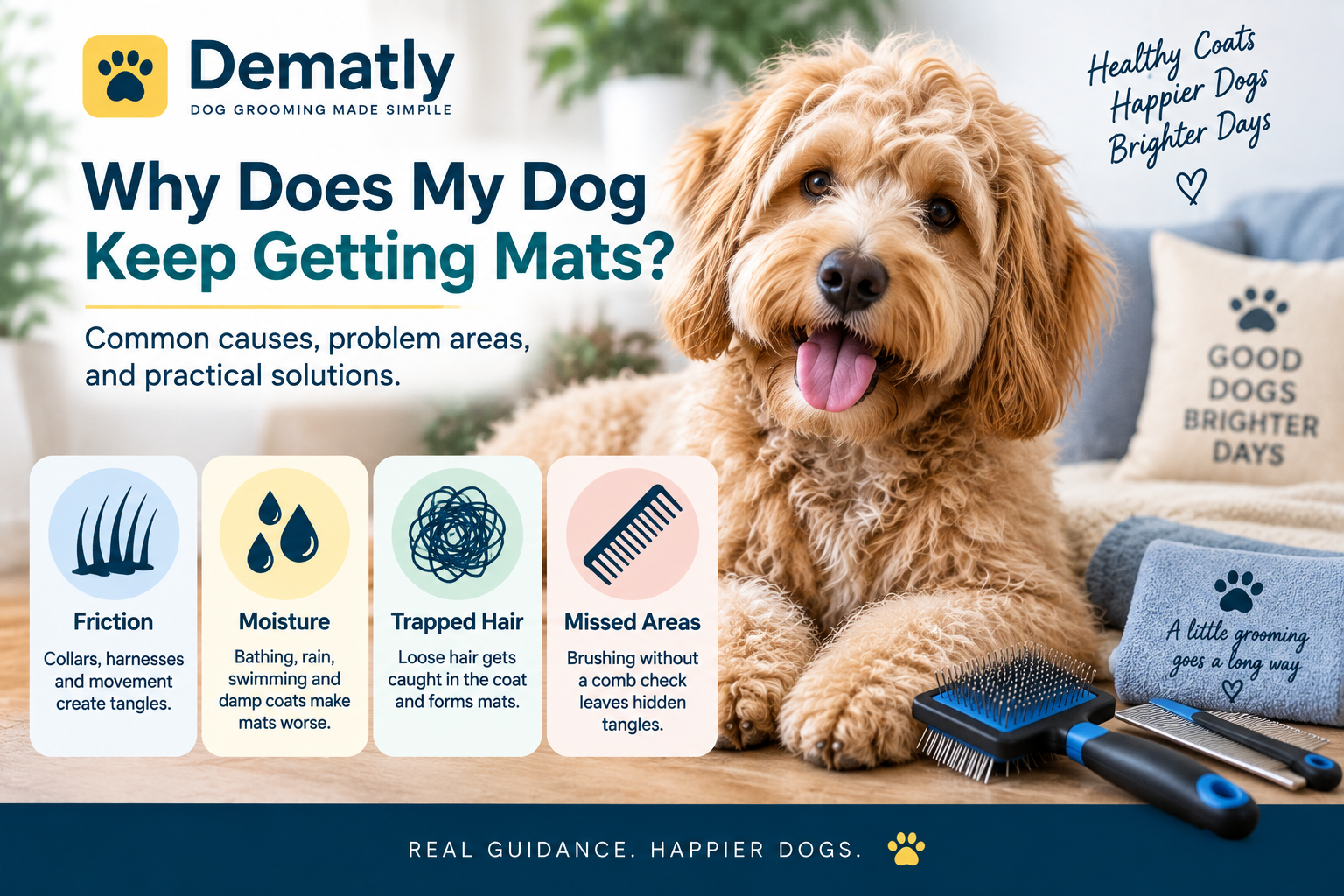
Suggested In-Article Image: Why Mats Keep Coming Back
A second useful image could show four simple causes:
- friction
- trapped loose hair
- moisture
- missed comb checks
Recommended file name:why-dog-mats-keep-coming-back.png
Recommended alt text:
Visual guide showing common reasons dog mats keep returning, including friction, moisture, trapped hair, and missed comb checks.
Can Detangling Spray Prevent Mats?
A dog-safe conditioning or detangling spray may reduce friction and make brushing easier.
It can be useful for:
- long coats
- silky coats
- feathering
- small loose tangles
But it will not fix severe matting.
Do not soak a tight mat and then force a brush through it.
If the mat is painful or close to the skin, stop.
What About Dematting Tools?
Dematting tools can sometimes help with small loose tangles.
But they can also:
- pull hair
- scratch skin
- cut coat
- cause pain when used aggressively
They are not the right answer for every mat.
The tighter the mat, the more cautious you should be.
If you are unsure, ask a groomer to show you what is safe for your dog’s coat.
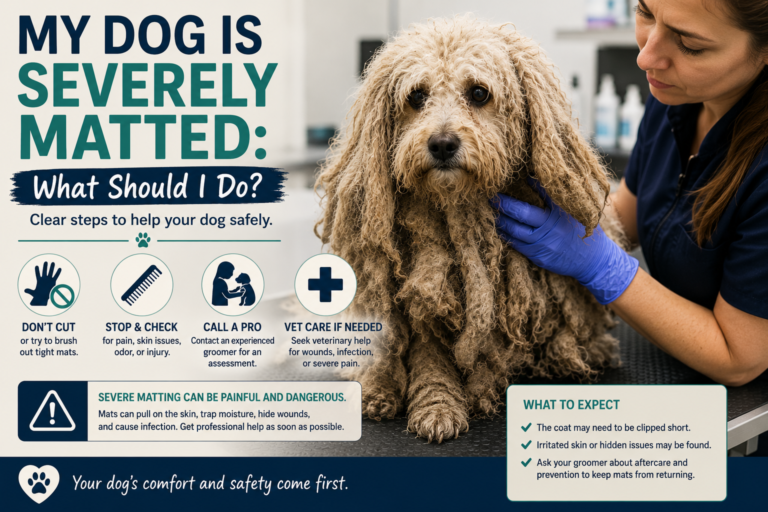
Do Not Cut Mats Out With Scissors
This deserves repeating.
Do not slide household scissors underneath tight mats.
Skin can be pulled upward into the mat, making it difficult to tell where hair ends and skin begins.
AKC advises owners not to cut mats out themselves with household scissors because sudden movement can result in serious injury. (American Kennel Club)
If a mat is tight enough that you are thinking about scissors, call a groomer.
When Mats Become a Health Problem
Mats are not always just cosmetic.
The ASPCA warns that mats can cause skin irritation, hide parasites, and in severe cases tighten enough to create wounds and interfere with circulation. (ASPCA)
Contact a professional groomer when:
- mats are tight against the skin
- large areas are connected
- the dog cannot tolerate brushing
- you cannot safely reach underneath the coat
- mats are around delicate areas
Contact a veterinarian when you find:
- open wounds
- bleeding
- swelling
- pus
- strong odor
- severe pain
- raw skin
- infection-looking areas
Read Wounds From Matting in Dogs if the skin underneath looks damaged.
Why Does My Dog Mat Behind the Ears?
Behind the ears is a perfect matting zone.
Hair rubs when the dog moves its head, scratches, sleeps, or wears a collar.
This area should be checked frequently.
Use your fingers first, then a comb.
Do not wait until a hard lump forms.
Why Does My Dog Mat Under the Armpits?
Armpits combine movement, friction, and often harness pressure.
That makes them one of the most common problem areas.
Lift each front leg gently and check underneath.
Dogs with long or curly coats may need this area checked every few days.
Why Does My Dog Mat Around the Tail?
Tail hair moves constantly and can collect debris.
Long feathering may tangle where the tail meets the body or along the underside.
Check after outdoor play and bathing.
Why Does My Dog Mat After Swimming?
Swimming wets the entire coat.
If the dog air-dries without being brushed and fully dried afterward, tangles can tighten.
For mat-prone dogs:
- rinse if needed
- towel blot
- dry thoroughly
- brush gently
- comb-check high-risk areas
Why Does My Dog Mat Under a Harness?
Harness straps create repeated friction.
This is especially important for:
- Doodles
- Poodles
- Shih Tzus
- Maltese
- Havanese
- long-haired mixed breeds
Take the harness off when it is not needed, and check beneath each strap regularly.
What If Mats Keep Returning Even With Regular Brushing?
Then something about the current routine needs changing.
Review:
- brush type
- brushing technique
- comb use
- frequency
- coat length
- drying method
- harness use
- grooming schedule
You may be brushing often enough but with the wrong tool.
You may be using the right tool but only brushing the surface.
You may be doing everything correctly while trying to maintain a coat length that is simply unrealistic for your schedule.
That is where a professional groomer can be very helpful.
Simple Mat-Prevention Routine
Daily or every few days
Check high-risk areas with your fingers.
Several times per week
Brush mat-prone coats thoroughly.
After brushing
Use a metal comb to check your work.
Before bathing
Remove loose tangles.
After bathing, swimming, or rain
Dry thoroughly and check again.
Every professional grooming visit
Ask where mats are forming and adjust the routine.
If mats keep returning
Consider more frequent grooming or a shorter haircut.
Final Thoughts
If your dog keeps getting mats, it does not necessarily mean you are not brushing enough.
The real cause may be:
- coat type
- friction
- trapped loose hair
- moisture
- surface brushing
- missed comb checks
- coat length
- grooming schedule
Find the pattern.
Once you know where the mats form and why, you can adjust the routine instead of constantly fighting the same problem.
The goal is not to maintain the longest possible coat.
The goal is a coat your dog can comfortably live in.
Related Dematly Resources
- How to Prevent Dog Matting
- How to Remove Matted Dog Hair
- My Dog Is Severely Matted: What Should I Do?
- Wounds From Matting in Dogs
- How Often Should You Brush a Dog?
- Dog Brush and Comb Finder
- Long-Haired Dog Grooming
- Curly Dog Coat Grooming
Dematly provides general educational dog-grooming information and does not replace advice from a veterinarian or qualified professional groomer.